
Where to Spot Otters on Quiet British Rivers
Start with the Signs Nobody Else Notices
The best woodland picnic spots in Britain are rarely signposted as picnic spots. They are marked, if they are marked at all, by a small yellow arrow on a wooden post at the edge of a village, half hidden behind a hawthorn hedge. Learning to read those signs is the whole skill. A public footpath disc means you have a legal right to walk, and in most cases a legal right to stop, sit and eat your sandwiches on the verge or in a clearing beside the path. That is where the quiet places hide.
Begin at the parish boundary. Old hedgerows — the thick, tangled, multi-species kind with hazel, field maple, dog rose and blackthorn mixed together — are usually a sign that the path beside them is ancient. Ancient paths tend to run along the edge of old woodland, and old woodland tends to have streams. Follow that logic and you will find more good picnic spots in a season than most people find in a lifetime.
Read the Landscape Before You Set Off
Do a little armchair reconnaissance the night before. Ordnance Survey Explorer maps, at 1:25,000 scale, show footpaths, streams, ponds, and — crucially — the little green tree symbols that mark woodland. What you are hunting for is a specific combination: a footpath, a stream, and a block of woodland all meeting within a few hundred metres of a road where you can park without blocking a gate.
- Contour lines close together mean a slope. A stream at the bottom of a slope usually has a flat, grassy bank beside it somewhere.
- Blue italic place names such as "Coldharbour" or "Winter's Hill" often mark old tracks and droves now used as footpaths.
- Access land is shown as a pale orange wash on modern maps. It usually means open country with a right to roam on foot.
- Bridleways are wider and often muddier than footpaths. For a picnic, footpaths are usually drier and quieter.
If you can find a path that leaves a village, crosses two fields, enters woodland and crosses a stream within a mile, you have almost certainly found a good spot.
Walk Away from the Car Park
This is the single most reliable rule. Wherever there is a car park, a tea room and an information board, the woodland within 400 metres is busy. Push past that invisible boundary and the crowd thins dramatically. Most people walk for ten minutes and stop. Walk for twenty-five and you will have the place to yourself.
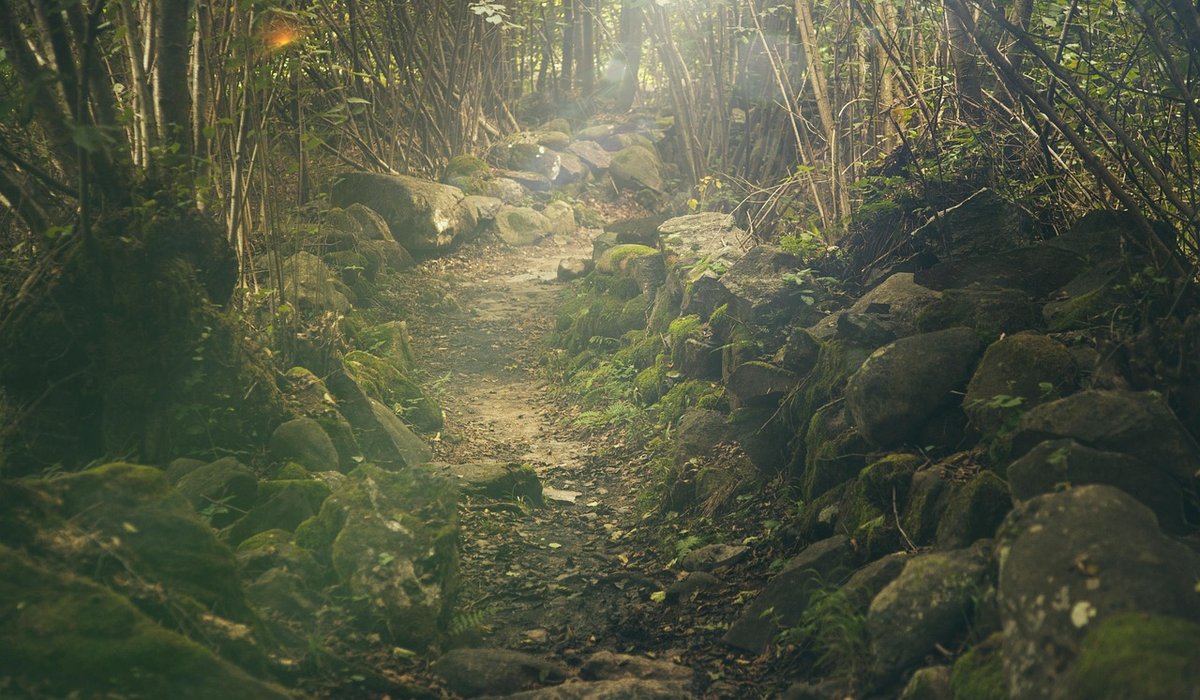
Follow the stream. Streams are the secret corridors of the British countryside. Paths often run beside them because the ground is level and the walking is easy, and the banks are frequently grassy, mossy and dry enough to sit on. Look for a bend where the water curves around a small promontory of land — these little peninsulas are sheltered, flat, and often have a natural seat in the form of a fallen branch or a smooth root.
Good signs you have arrived:
- The path narrows and the undergrowth closes in behind you.
- You can no longer hear traffic, only water and birdsong.
- There is a dry, level patch of grass or leaf litter clear of nettles and bracken.
- Bluebells, wood anemone or wild garlic are growing nearby — all indicators of ancient woodland.
What to Pack for a Woodland Picnic
Keep it simple and light. A flask of tea or coffee, sandwiches wrapped in paper, a bag of apples, and a small bag for your rubbish. Add a folded square of old blanket or a sit mat, because woodland ground is often damp even in August.
Other things worth carrying:
- A midge net or repellent from May to September, especially near water in Scotland and the Lake District.
- A tick card — check yourself and any dogs afterwards, particularly in long grass and bracken.
- A small knife or scissors for cutting brambles out of your chosen spot.
- A spare carrier bag for foraging finds — though check local rules before picking anything.
Leave no trace. Take everything home, including fruit peel, which can take years to break down in cool woodland soil and attracts vermin.
Quiet Pastimes to Go With the Quiet Place
Once you have found a hidden clearing, the picnic becomes a base for something slower. Birdwatching with a cheap pair of binoculars is the classic. So is sketching — a small notebook and a pencil weigh nothing. Some people carry a plant identification guide and spend an hour learning the names of what is growing around them.
Foraging is a fine companion to a woodland picnic, provided you follow the rules. On most public footpaths you may pick leaves, flowers, fruit and fungi for personal use, but you must not uproot plants, and commercial foraging needs permission. Never eat anything you cannot identify with absolute certainty. Wild garlic in spring is easy and safe to learn; mushrooms are not.
Other gentle options:
- Letterboxing and geocaching, which give a purpose to a wander and often lead to spots you would never otherwise find.
- Mindful walking — a slow mile with no phone is a surprisingly good use of an afternoon.
- Reading aloud, if you have company. A chapter of something old and English suits a beech wood very well.
Finally, treat the place as a secret. Tell a friend, not the internet. The best woodland picnics are the ones nobody else knows about, and a little discretion keeps them that way.
LEAVE A COMMENT